Showing posts with label refugees. Show all posts

08 July 2008

More Famous than Ben Affleck

On Thursday a delegation of VIPs from the Congo and UNHCR came to talk to the refugees. I asked if I could bring the bub and the Cripple along in the afternoon as we would just be sitting and listening to people talk (and I’ve learned that in Rwanda people really like to talk, so it would probably be quite a long event). The camp director said sure I could bring her, but we would be mobbed so it was my decision to make. I didn’t quite believe her.

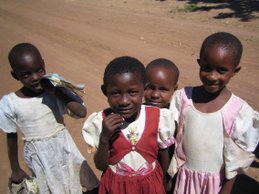
See, everywhere we go crowds of people come to wave and shake and the bubs hand. She loves the attention! The first time I took her into the camp she probably drew a crowd of about a hundred children, and she was a bit scared (she was also not feeling very well and had just had a nasty shot), but she went in again the next day for a check up and just waved when all the children came up to her. Every day the Cripple takes her out on walks and she draws crowds of children from the nearby school that come and shake her hands and stroke her head. She blows kisses and raspberries at them. When the Cripple takes her into church she sings along with the music and spends all her time trying to get to the other children. So I figured she’d be happy to get the attention.

As soon as we arrived I realised I’d vastly underestimated the scale of the event. I think virtually every refugee (and there are about 18,000 of them) had come to hear the speakers. There were so many hoards of people small children had climbed up the basketball basket – I really can’t imagine how – and were sitting on the hoop or hanging off the net in order to get a better view!

The delegates were just beginning to talk so we were quickly ushered around the side to the benches behind them. Though there were a few, mostly older, refugees sitting behind us on the few seats provided for VIPs, the vast majority of the many thousand attending were standing in front of us. Behind us a refugee who I’d met the week before was sitting. He offered to translate the proceedings for us and sat there diligently writing what was said. After a good hour and a half the talk finished and we thanked him profusely for his kindness. Apparently the delegates had come to try to talk the refugees into going back the Congo. They were promised their houses and property back and told the situation is secure enough for them to go. We asked the refugee what he thought of this and he gave a rather neutral answer (I should point out, all the delegates were still sitting in the row in front of us).

As we were a bit distracted talking to the people behind us we didn’t notice all the VIPs leaving. Suddenly I realised there was just us and a few thousand refugees left. As we came round the side of the shelter a huge wave of children surged forward. I suddenly realised what the camp director had meant.

Oh dear.

The Cripple and I made our way, as best we could, in the direction of what we thought were the NGO vehicles in the medical centre. The children, absolutely fascinated by the bub, screamed in joy and threw all their weight into getting close enough to touch us. Some of the refugee guards stepped in and tried to keep the children back by hitting their legs with switches. We were appalled, but really, there seemed to be no alternative. We finally get through to a space in the crowd and groan when we realise we’ve come to the UNHCR boarding point, not our own. The medical centre is back around a long fence that literally thousands of children seem to be hanging off and squashed up behind.

Starting to get a bit frantic I ask the single police officer if there is a back way to the medical centre. He says no and turns his back on us. Not two seconds later the fence starts to collapse and dozens of children fall off. The police officer rushes over and says yes, there is a back way. We follow someone as fast as we can away from the hoards.

After ten minutes of speed walking through a maze of locked gates we’re back in the medical centre. The camp director laughs at us and says “see I told you you’d be mobbed.” A couple of months ago Ben Affleck came to visit the camp. As hundreds of children squash their faces up to the fence to get a better look, I ask the camp director if they acted the same way when he visited. “No, no, no. She’s more famous than Ben Affleck!”

While waiting in the security of the compound, we thought about the talks we’d just heard. We wondered how, twelve or thirteen years on, authorities could know which house belonged to whom, and even if the houses were still standing. I asked some other refugees in the medical centre what they thought. One of them said “How can I return? The Interahamwe have taken our village. They live their now.” That night one of the staff at the NGO we’ve been staying with commented that there was conflict in the region they fled from last week. Over the weekend an NGO worker in North Kivu (the area the refugees fled from) said with astonishment “But the Interahamwe are in their villages!”

28 March 2007

Kibuye and Kiziba camp

I didn't realise the buses ran so infrequently to Kibuye (every two hours) and only just caught the last one on Saturday arriving after dark. Kibuye is quite small and there were no taxis about, only moto-taxis, and as I was travelling with my suitcase the only possibility of getting to the guesthouse was on foot. After a few minutes walking I was joined by a young man who offered to carry my suitcase for me. Being somewhat paranoid I turned him down but he kept walking with me asking some questions in English and French, both of us struggling to communicate. When I arrived at the guesthouse about half an hour later he said au revoir and turned around and walked back up the hill we'd just come down. I realised too late he'd been walking with me just to make sure I'd gotten there safely.


In the morning I was so glad to have a full day to rest before going to the camp. The views of Lake Kivu were beautiful and I spent several hours walking around the village exploring. Eventually I found a small beach used by the residents to bathe and fish from and spread out my towel to sunbathe. Every few minutes different groups of children would come and talk to me or passersby stopped to stare.


On Monday I met up with some of the NGO staff and set off for Kiziba refugee camp. It was then that I realised Kibuye is small: when I was introduced to a couple of the workers they told me they'd seen me sunbathing the day before! The camp is about half an hour from Kibuye down a road which at times is incredibly bumpy and you can easily invision slipping over the edge in a downpour. It was without a doubt the worst road I've seen in Rwanda, the workers laughed when I said that and told me it used to be much worse.


The stories I heard in Kiziba were similar to those I'd heard in Gihembe: the refugees didn't have enough firewood, food or sheeting and other materials to build houses. They often had to sell the few things they were given so they could provide more nutricious food, clothes and other things for their families. Kiziba also has a severe land shortage and is housing the seventeen and a half thousand refugees that live there on less than half the amount of land they should have for that number. In addition to overcrowding, it means that latrine and shower facilities are stretched thin and there was a real concern of a cholera outbreak in the camp should it be brought in from outside (there are reports of cholera at the moment in nearby Gisenyi so this is a very real threat).


While I was at Kiziba, I met the handicapped women's association (above) who, with the help of a microcredit programme in the camp, make lovely colourful bags and sell them. Since they began they've expanded from just a couple of members to training more than twenty who are now able to supplement their provisions with income from the association. It takes two women a whole week to create the bags which they sell for 6000 Rwandan Francs (about US$12).


This morning I ate breakfast and said goodbye to Kibuye while enjoying views of Lake Kivu and the Congo in the distance.

24 March 2007

Gihembe refugee camp

Many people don't realise that Rwanda is the home of many thousands of refugees stemming from different conflicts in the region. This week I visited one of the largest refugee camps in the country, Gihembe, which is about an hour north of Kigali quite close to Byumba, a Rwandan town with a fairly large population in the middle of a tea growing region that provides jobs for about 60,000 people. Gihembe is home to about 17,500 Congolese refugees many of which have been living there almost ten years now.

Ten years.

There are still regular reports of violence in the border areas of the DRC from which they fled. Despite massive funding cuts and UNHCR's (UN High Commission for Refugees) hope that the refugees will voluntarily return soon, stability doesn't look promising across the border. Especially after yesterday's reports that there has been fighting in Kinshasa and Jean-Pierre Bemba, the runner up in last year's election and the DRC's opposition leader, has been accused of treason. The Rwandan government wants the refugees to return, but after one attempt a few years ago which saw the refugees attacked as soon as they arrived in the Congo and back at the camp within a few weeks, it seems unlikely that they will be convinced as long as their home continues to experience regular outbreaks of violence.


The camp itself is a few kilometers from Byumba, set high on the top of a nearby hill. From the distance you can make out the white sheeting the refugees are given by UNHCR to constuct their houses. Byumba itself is at a high altitude and quite cold at night, the refugees in Gihembe are all the way at the top of the hill and only have the sheeting to insulate them from the rain and wind and thin UNHCR issue blankets to block out the cold. It's rainy season and every night I spent in Byumba the pouring rain woke me up repeatedly. Sleeping under plastic sheeting, most of the time torn plastic sheeting, wet and cold must be virtually impossible.


There were many, many children in the camp, crowds of them followed me around all the time I was there. Some of the camp workers told me that one of the biggest problems in the camp is the lack of food. Refugees are only given very limited supplies of maize and cooking oil and often must sell some of their ration so they can supplement their diet with fruit and vegetables and buy clothes and other necessary supplies that aren't provided. Some lucky refugees have found low-paying jobs within the camps, but many more have to search outside for work and find that their status affects the positions they can take and reduces their pay considerably. Family planning efforts are having virtually no effect in the camps as families purposefully increase the number of children to increase their food rations. A six month old baby is given the same monthly food ration as an adult, many refugees see only the short term food gain in having another baby and not the long term consequences of even more mouths to feed and backs to clothe.


The staff I spoke to at the camp were quite amazing - in the face of hard and depressing working conditions and wages that with inflation get lower each year they are trying their best to help the people under their care. One of things I was told repeatedly was that the scarce resources and status of the refugees within Rwanda makes it very difficult for them to adequately provide for families and that the biggest losers tend to be adolescent girls. Sexual exploitation becomes almost inevitable when the girls aren't given clothing within the camps, their parents can't afford to provide it, they can't work and they have no other way to dress themselves than to find an older man who will buy them things or otherwise prostitute themselves.

A lot of sexual abuse occurs when women and girls leave the camp in search of work or firewood in remote areas. Counsellors told me that in Congolese culture rape is taboo to discuss and therefore many women don't come forward and talk about what has happened to them. They have been working hard to sensitise the community and encourage women to come forward, but this hasn't been help by the refugees status. Because they are not Rwandan, refugees accused of rape will only face jail for a few days before they are let go and return to the camp. There seems to be no way to hold prisoners indefinitely no matter what the crime.

On Thursday, I had my own rather frightening experience of this. When I first arrived at the camp a guy in handcuffs came up to me and shouted a bit and staff led him away telling me he had gone crazy after experiencing the war in Congo. They seemed resigned to him and treated him as if he was harmless so I didn't think any more about it. Thursday morning one of the refugees was leading me through the medical area to find someone I had a meeting with when suddenly she ran through the gate to the compound and it was locked just in front of me. I turned around and the crazy man was running at me shouting "Why are you afraid of me" as I tried to back away from him. He pushed me and kicked me before security managed to grab him and take him away and I slipped through the gate. I thought after that he would have been locked up, but in the evening when I was about to leave the camp he appeared and chased after me again but this time there were more people around that took him away before he could get too close to me.

The next day, after he had been sent to the mental hospital in Kigali, the camp director told me that the guards were afraid of him because he had killed both his parents. The prisons wouldn't keep him because he was a refugee and not Rwandan. He had been sent to the mental hospital in Kigali many times but they always discharged him after a few days and returned him to the camp, she hoped that this time he would be kept there but the prospects were slim.