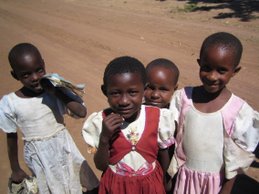
Just as close as they appear
07 February 2006

04 February 2006
Gambia Maybe Time
Hello from hot and sunny Kotu Beach, the Gambia. Maz and I left the absolutely freezing streets of London yesterday morning thinking it wouldn't be possible to survive in temperatures any colder and spent the evening walking a long the beach barefoot. The cold that I had when I left England has almost dissappeared with the warm weather.
We had heard quite a lot about sex tourism here before we came (as has just about everyone it seems!), though watching the middle age women with boys 1/2 their age is a sight that can only really be seen to be believed. Thanks to this wonderful practice, we've found it completely impossible to walk anywhere unaccompanied by 'bumsters' who seem harmless but are rather irritating. This morning we went to the markets in Serrekundu (the largest city in the Gambia) and spent an hour or so walking round with a constant companion telling us "relax and take it easy, I'm not hassling you," If that is so, I dread to think what hassling is!
Now that we've missed the peak sun hours, we'll spent the afternoon lounging on the beach and relaxing :)

19 January 2006
Some good news in the new year?
Today Justin Gillis wrote that a Once-a-Day AIDS Pill Could Be Ready Soon in the Washington Post. This is, ofcourse, good news. Having to take only one pill a day means treatment regimens are easier to maintain, patients won't get as sick and drug resistant strains are less likely to develop. Though "[t]he pill won't be ideal for women of child-bearing age, since it may cause birth defects." The group most affected by HIV/AIDS worldwide, won't be able to use this new drug. The eternal cynic in me noticed this sentence:
"With nearly two dozen AIDS drugs on the market, with many more on the way, and with the patients taking them expecting to live out normal life spans, companies say devising convenient regimens has become a make-or-break problem."and it made me wonder: isn't this the perfect market for drug companies? I know it's been said before, but an ever-increasing population forced to maintain drug regimens for their entire natural life, it all seems too perfect. What incentive do pharmaceutical companies have to develop a cure for AIDS? No matter how hard we try to treat the rapidly multiplying numbers of people affected by HIV/AIDS in developing countries, until there is a cure the poorest will continue to have far higher HIV infection and AIDS mortality rates.
The Post also reports that the NIH Halts International AIDS Study testing whether breaks from anti-retroviral drugs had an effect on drug effectiveness. Unsurprisingly, the trial "showed that patients had twice the risk of dying or developing clinical AIDS if they took breaks from the drug cocktails, called highly active antiretroviral therapy." This has major implications for donor agencies funding treatment in developing countries. While there are now several programmes offering developing countries assistance for ART (anti-retroviral treatment) that are expected to increase their investment in the coming years, it is crucial that these programmes don't, as all too often happens, have their funding cut in future budgets. Pressure must be kept up to ensure that the Global Fund, the WHO's 3*5, and other AIDS treatment programmes are maintained as even short breaks in treatment can increase the development of drug resistant HIV strains, cause earlier AIDS onset and more illness for those with HIV/AIDS.
08 December 2005
African Women Confront Bush’s AIDS Policy
Yifat Susskind of Foreign Policy in Focus writes:
...[G]rowing numbers of people around the world know that sub-Saharan Africa is the epicenter of the AIDS pandemic: three-quarters of AIDS deaths worldwide have been in Africa, and today the continent is home to nearly two-thirds of all of those who are HIV-positive (more than 25 million people). Fewer people know that most Africans living with HIV/AIDS are women, and that young women are now being infected at a rate three to four times higher than young men. For many, this information is absorbed through a mesh of stereotypes that make human misery
seem like a natural condition of life in Africa .
But while AIDS—like the litany of this year's natural disasters—may have originated in nature, the magnitude of its destruction is a man-made catastrophe. Consider the following:AIDS, unjust economic policies, and women's inequality are mutually reinforcing crises; combating any one of these requires addressing them together. But too often, public health programs, government policies, and even activists compartmentalize issues, missing critical points of inter-connection that are keys to effecting change.
- Since the 1980s when AIDS first emerged, the United States has demanded “economic austerity measures” in impoverished countries. In Africa , these policies cut national health budgets in half just when public health systems needed to be ramped up to combat AIDS. Today, the pandemic is the single
greatest obstacle to economic development in Africa .- To bolster already-huge profits of U.S. pharmaceutical companies, the Bush administration has blocked the sale of affordable generic drugs that have saved millions of lives in rich countries.
- Women are made particularly vulnerable to HIV infection because they are denied the rights to refuse sex or insist on condom use. As the majority of those living in poverty and the poorest of the poor, women are more likely to contract HIV and more likely to develop symptoms of AIDS soon after they are infected.
02 December 2005
AIDS in DC
The press coverage yesterday was depressingly scarce. 18 years of World AIDS Days and I guess everyone just doesn't care anymore.
Today the Washington Post's Darragh Johnson talked about the Whitman Walker clinic's mobile testing unit that was out on the streets yesterday. Despite the fact that:
Washington's rate of infection is alarmingly high -- at Whitman-Walker's clinic in Southeast the positive test rate is 6 percent -- and it's not going down. In 2001, in cities with more than a half-million residents, the relative numbers of Washingtonians infected with AIDS outpaced the country's other big cities, according to a thick report on "HIV/AIDS in the Nation's Capital," released in August by D.C. Appleseed Center for Law and Justice, a public interest organization.
So. To recap. Each of the numbers below represents the number of AIDS cases per 100,000 residents in 2001:
Washington -- 119
Baltimore -- 117
San Francisco -- 67
New York -- 64
Philadelphia -- 58
In 2003, two years later, D.C.'s number had jumped to 170.
(Johnson [2005] "In a City With A Big Problem, Trying to
Turn A Corner on AIDS" The Washington Post 2Dec05 )
Noone wants to get tested. The mobile testing unit spent the day hanging out and encouraging people to come and find out their status, but to little effect.
*
Some good news: Yesterday the Guardian reported:
Europe, led by the UK, last night signalled a major split with the United States over curbing the Aids pandemic in a statement that tacitly urged African governments not to heed the abstinence-focused agenda of the Bush administration.
(Bosely [2005] "Europeans reject abstinence message
in split with US on Aids " The Guardian 1Dec05)
28 November 2005


Patti Smith & other Adventures in Amsterdam
On Thursday I arrived in Amsterdam... and wow. This just really seems to be the city of the future. It's kind of hard to believe that the Dutch have got it so right... I mean, what on earth are we doing in the rest of the world? Granted, I've only been here a few days, but the overall impression is one of serenity and efficiency. Public transportation is great, police presence verging on nill, and despite what you would think, no public 'scenes' so endemic of US/UK societies on a weekend.
Maz and I have had a wonderful time relaxing and catching up the past few days. On Saturday we went to see Patti Smith at Paradiso which is a converted church and must be the coolest place to see a gig ever. I've never really listened to Patti much, but she was incredible live. Despite being a living legend, she has to be the most unaffected musician ever (and yeah, I'm including all the musicians I know that aren't anywhere close to being a legend!).
The hostel is a bit dull, but clean and warm (and at 27 I think maybe that should be my main criteria for hostelling). The red light district was a strange sight, the city goes from picturesque to ummmm pornographic in a few steps. But crime seems to be a lot lower and we did find our fave hang out spot of the weekend slap bang in the middle (just in case you're concerned, I am leaving with far less money than I arrived with!).
I don't think I've ever had such a great weekend :)
23 November 2005
Morality and AIDS
It has been far too long since I last posted... somehow every day life never seems to compare to the urgency and immediacy of travelling. I always find I am thinking much more deeply about things and write far more in a new environment than I do at 'home' - wherever that may be at the time.
I just had an email asking me if I didn't think 'moral issues' were at the root of the AIDS epidemic in Africa. No - I don't. I think the root cause of AIDS is a particularly clever 'germ' that has learned to spread through sex (or human reproduction) something we humans are highly embarrassed about and something we will continue to do, furtively and otherwise, until we are extinct. I'm not a biologist and can't document the way the virus has evolved and spreads biologically, but would recommend reading Guns, Germs and Steel to see how germs develop and AIDS in the 21st Century for more on the biological transmission of the virus.
I can tell you that women are much more vulnerable to infection (both biologically and socio-economically) and that poverty is a major factor in the spread of HIV/AIDS. Conditions of poverty lead to poor nutrition, higher exposure to disease and suppressed immune responses. A compromised immune system is much less able to resist the attack of the HIV virus. Poverty also decreases options. Faced with the choice between starvation and possible illness later, most people concentrate on short-term survival. This pushes millions of women around the world into sex work, and millions more into dependent relationships.
The reason why Africa, as opposed to say the US, is the most heavily affected region is due to many, many reasons, but not 'morals.' Probably the two most important are the level of extreme poverty (in sub-Saharan Africa, 83% of children are severely deprived of at least one basic human need: food, safe drinking water, sanitation, health care, education, shelter) and that health care is minimal and treatment rare. Sub-Saharan Africa has the highest percentage of untreated STI's: it has been proven that untreated STI's increase transmission risk. HIV is far more likely to be transmitted just after infection and in the final stages of the disease (when viral loads are high), treatment reduces viral loads and thereby decreases new infections. Treatment also acts as a deterrant by reducing stigma and encouraging testing; those who have an incentive to protect themselves if HIV-negative and the knowledge to protect others if HIV-positive.
"As so many of our patients have noted, what is the motivation for learning one’s serostatus [HIV status] when there is no possibility of being treated for opportunistic infections or of access to prevention of mother-to-child transmission during pregnancy, much less of being treated with antiretrovirals when needed?"It is noteworthy that the most common AIDS-related assistance to heavily burdened countries has consisted of education about the disease and condom distribution to prevent HIV transmission. Many of those at greatest risk know that HIV is a sexually transmitted disease and that condoms can prevent transmission.
(Castro and Farmer (2005) “Understanding and Addressing AIDS-Related Stigma: from Anthropological Theory to Clinical Practice in Haiti” American Journal of Public Health Vol. 95, No.1 pp.53-59)
Their risk stems less from ignorance and more from the precarious situations in which hundreds of millions live; gender inequality adds a special burden, and is the main reason that, globally, HIV incidence is now higher among women than among men.
(Farmer et al., (2001) “Community Based Approaches to HIV Treatment in Resource-Poor Settings” The Lancet Vol. 358 pp.404-409)
The prevention strategies currently used will not stop HIV incidence or AIDS deaths among the poorest populations, especially among poor women. It is time to focus attention on treating the millions already affected, both as a moral necessity and a wise investment in the future. Treatment, both antiretroviral and for opportunistic infections, must become integrated in the fight to combat HIV/AIDS in all countries and in all communities.
27 June 2005
Maasai village

Between safaris in the Serengeti and Ngorongoro Crater, we stopped at a Maasai village. We visited a school and the children were really impressive - nursery class counted to 40 (made me realise how little I had taught my class!)
Thoughts, reflections and things left unsaid
I've only been back a few hours but it already feels like my time in Tanzania could have been a dream. I think the most significant lesson I learned is that maybe the most important thing in life is your attitude. It was easy to be narrow minded and not think about the struggles of people around me: to feel frustrated at hustlers trying to sell their wares instead of respect at the persistence with which they try to eke out their minimal existence. On days I allowed myself to feel irritated, everything seemed to build up becoming more and more frustrating and alien. On days I thought more about the position of people around me, I felt humbled and extremely lucky. My trip was a truly amazing experience and one that I was only able to indulge in because of my extremely privileged background.
One of the things I will remember and admire the most about Tanzanians is their kindness and generosity. Travelling by myself in a strange country was perhaps the most daunting thing I’ve ever done, but I met such astonishingly good people my journey was much easier. Everywhere I went along the way I was invited into the homes and lives of people who had to nothing to gain from their kindness. People offered to help me find hotels, meet me in air and ferry ports, take me around town and even to stay in their house when they weren’t there!
I’ve read sooooo many books and studies on Africa, but nothing compares to actually seeing the everyday struggles of people. Being in a village that is only connected to minimal health care facilities through dodgy dirt roads and seeing the huge obstacles people face every day just to get to work things make much more sense. If nothing else, I come away from my stay in Tanzania with the overwhelming sense that infrastructure (roads, buildings, access to clean water) must be improved first and foremost. Children can’t go to school if they have diarreah from unsafe drinking water, the school is too far away for them to travel, or the roads are so dangerous they cause an accident that kills them on the way. Women would have more time to study if they spent less time fetching unsafe water; the more educated a woman is the less likely she is to catch HIV. I keep hearing that throwing money at the problem won’t help, which is true to a certain extent: throwing money at corrupt officials won’t help at all. But cutting off funding when so much needs to be done is not the solution either: development aid needs to be effectively spent so that people have a fighting chance of improving their lives. I’m not sure if my students learned anything during my weeks with them, but they (and everyone else I met) definitely taught me!
24 June 2005
scooting round Stonetown
The past three days have been a blur - literally. I've had so much sand and grit in my eyes from zooming around Zanzibar on the back of a scooter that most of the time I haven't been able to see a thing. The first two days I really enjoyed it, but today, 1/2 way into the journey to Nungwi beach at the very tip of Zanzibar, I felt so sore I would have gladly given up the convenience of scooting for the "comfort" of a dalla-dalla. On the way back, I would gladly have paid big bucks for the dalla-dalla comfort, only the fear of offending my host that kept me glued to my rock-hard seat (for those of you that think I'm exaggerating - I have bruises!).
Despite my discomfort, Zanzibar really is paradise. I thought all beaches were pretty much the same, but today I was astonished. The sand was white, the water warm and turquoise, and the waves broke so gently next to the shore it was impossible not to dive in. I've never understood why people are so obsessed with going to the beach, but after Nungwi, I get it. I toured a spice farm early in the day, afterwards we 'sampled' some of the most heavenly fruits I've ever eaten. Starfruit, mangoes, tangerines and many more which I don't remember the names of, but after all the rice and beans I've eaten over the weeks, it seemed a world apart.
I keep seeing signs for WHO, ActionAid, Save the Children, et al's Zanzibar office and thinking what a blessed existence the staff must have to get posted here. It's hard to remember with the seeming abundance that poverty is much more rife than you'd at first believe. One rather sordid measure of this is the plentiful sight of middle aged muzungos cavorting with teenage prostitutes in just about any bar you go to in town.
23 June 2005
Nungwi beach

All the way at the top of Zanzibar, Nungwi beach was gorgeous and well worth the harrowing journey.
Mtoni Palace Ruins

This is where the Sultan Said lived briefly. He kept his favourite of the 99 concubines (slaves) here to be used at his pleasure. The ones that fell out of favour would be returned to the auction block and replaced quickly.

Subscribe to:
Posts (Atom)