20 June 2005

ICC Arusha

Monday morning I sat in on the one of the courts for International Criminal Tribunal for Rwanda and heard a woman talk about the genocide. She testified that one of her family members had convinced a group of Tutsi's to come out after a week of hiding because peace had been restored. When she and the others came out and registered the men were immediately killed by machete's and clubs. The ones that had any money paid soldiers to shoot them so they would die by gunshot instead. The women and children were rounded up and handed over to armed soldiers who gang raped the women repeatedly. It was heartbreaking to hear her testimony, especially as it was continually interrupted by objections from the defense. The prosecuter asked for a closed courtroom because she was going to name people who would know her identity and it could be dangerous for her as they were out of prison. After strenuous objections from the defense it was eventually granted by the judges and I had to leave.

This morning I went back for a couple of hours before my flight left Arusha. I met Lincoln, a reseacher from NY, who saw the initial cross-examination yesterday after I had left. He told me the defense had really been badgering the witness, especially about inconsistencies in the French and English statements she signed. The witness spoke Kinyarwandan, and couldn't read or write: how she was expected to spot inconsistencies in two languages she didn't speak when she is illiterate is beyond me. Today the defense continued to berate the witness, calling her a liar and at times yelling at her. I know it's their job, but it was very frustrating to watch the defense attorney's treatment of the witness. I felt that most of the questions the lawyers asked the witness were designed to be misleading. My overall impression of watching (admittedly very little of) the trial, was that justice really fails the poor and uneducated.

19 June 2005

the Serengeti

When I started planning my time in Tanzania, it never occured to me to go on safari. My goal was to help the children and learn as much as possible about poverty, HIV and just life in general in a developing country. After much encouragement from my mum, and a mass decision from the volunteer group, I left on Thursday morning for the Serengeti. It was a wonderful experience and something I will never forget. We spent two days in the Serengeti and a day at Ngorongoro Crater. The animals were beautiful and it was so nice to see them in the wild. I don't think I will be able to go to the zoo after seeing a lioness play with her cubs a few feet away and a herd of giraffe happily eating together on the Serengeti plain. The safari was an extremely different reality than what I had experienced for a month in Mwanza. Instead of being the only cluster of Muzungos in town, the only Tanzanians we saw were 'servants'. After being used to beans and rice (or ugali) for weeks on end, the buffet table had every Western food you could imagine. Instead of walking or catching dalladallas everywhere we had our own driver. It was quite surreal to for us (the volunteers) to be able to enjoy ourselves to such an extreme extent after witnessing the every day struggles of most people here. It was a fabulous experience, but one that I am extremely glad I had after seeing what Tanzania is really like.


The Serengeti wildebeest migration


Duma (Cheetah and Cub)
Our guide in the Serengeti told us he had been doing safari's since 1978 and never seen a Cheetah in a tree before!


Twiga
The Giraffe was one of my favourite animals.


Simba
This lion was rather shy and hid from us as soon as we approached, the lioness was inches from us and didn't move when we approached!

15 June 2005

Goodbye Mwanza

Sadly, after a month at the orphanage, most of the other volunteers and I were concerned about the accounting and felt that the director was not being entirely straight with us. Although it must be emphasized we have no proof of any wrong doing, the prices Fred quoted us for things seemed to be extremely high. Whether the reason for this was because he assumed we had loads of money and wasn't bargaining or something more sinister, I didn't feel comfortable handing over cash to Hisani. I decided it was best to give things, not money, to Hisani. The children loved the toys and colouring supplies I brought with me. Unfortunately, the dresses I had made for the girls weren`t ready on my last day, so Rachel has promised to pick up the dresses next week and take photos so I can post them on here. Over the past few weeks I have talked to Joseph at length and seen how transparent his accounting and fundraising is and that his participation in the community is truly making a difference to so many lives. I decided that the leftover money I had fundraised would go much farther at Fonelisco and gave him US$100 for his orphans.

Although there were times I felt I was loosing an uphill battle, I learned so much at Hisani and I will always treasure my time there. The memories of the children's love, hope and resilience in the face of such overwhelming hardship will continue to inspire me. I loved teaching and playing with them, and saying goodbye on Wednesday night was one of the hardest things I`ve ever done. To be completely honest, I only lasted an hour at the goodbye dinner because I was too upset to stay any longer.


Biala and Matungwa at the goodbye feast
Our last night in Buswelu - Biala clearly had enough to eat!

14 June 2005

Streetkids

I wandered through the market trying to block out the noise of all the onlookers screaming at me. I was in no mood to try and fend off the enterpreneurs, taxi drivers or beggars all trying to catch my attention in hopes of making their evening meal. I repeated hapana, hapana, hapana (no) as I walked with my eyes down trying to keep the attention I was getting to an absolute minimum. I was so in my own world that I almost snapped hapana at a little boy who came up to me asking for something to eat. I bit my tongue just in time and did a double take. The reason I came to Tanzania was to try and help children like him, and yet I almost dismissed him out of hand. He had sulked back into the shadows, expecting me, like everyone else, not to help him.

I told him to njoo hapa (come here) and three more little boys came out of the shadows and started following me. I took them to the pizzeria place down the street and after washing we all sat down for dinner. Nickolas, Jameson, Ngusha and Samwel (10-12) were soon joined by Brian (9) and were all very sweet and told me they wanted to come home with me. I explained that I couldn't adopt them (legally, the government of Tanzania won't let people adopt unless they have been a resident here for 2 years - so all of you back home can breath a sigh of relief!) but that they could go to an orphanage if they wanted a place to stay. They all told me they wanted to go, so I called Joseph who said he would be happy to take them in. I gave them all Fonelisco's address (it is close to the city centre) and they promised me they would go - I just hope they do.

Spending an hour with the boys made me feel so much better. It made me realise that even though being asked for money all the time is really frustrating, and feeling like I am constantly being ripped off is a bit frustrating, I am so lucky. I can't imagine the resilience of being nine years old and trying to scrape together my next meal every day and a place that's safe to sleep each night.

13 June 2005

Mwanza -> Missungwe -> Ngudu -> Mwanza

I left Mwanza very early and arrived in Missungwe at 9 o'clock yesterday to find all the dispensaries (local doctor's offices) closed. After walking around the village for a bit Patrice and I finally found someone that worked at the dispensary, who said he would go off and find his boss and open the office up. While we were waiting for him to come back, we hopped on bicycle dalla-dalla's to the hospital in search of their VCT (voluntary testing and counseling) unit. We were told again that as it was a Sunday, the VCT unit was closed, but the doctor on duty talked to us about HIV in the area and estimated that about 1/3 of the people in Missungwe were HIV positive and as yet, there was no provision of ARV drugs in the district. Anyone who's t-cell count was low enough that they needed ARVs would either need to pile into a dalla-dalla for over an hour to reach Mwanza (not very feasible in the advance stages of HIV disease [AIDS] when diarrohea is often present) or have to pay for the medications themselves at retail price (not an option for the vast majority of the very poor district). When we returned to the dispensary, we talked to the head of the lab who had come into work especially to talk to us. He told us that the local dispensaries (which due to the sparsely distributed population are usually the only health facilities most people in Tanzania can access) are not able to talk to people about HIV, test for HIV, or prescribe ARVs.

The bus to Ngudu was the biggest vehicle I've traveled in yet, and easily the most frightening! By the time we arrived in Ngudu I was worn out by all the travel, but still had many people to meet. The first person I spoke to was the District officer in charge of AIDS, who told me that the only ARV medications available to people in the district were a single dose used to prevent mother to child transmission, there weren't any drugs available for ongoing treatment of AIDS patients. Again, people that needed ARVs had to travel to Mwanza (2.5 hours away on the fastest route) or buy them themselves. I spent just over 24 hours in Ngudu and met the chief executive officer, his secretary, the district commissioner, the executive officer of the hospital, the chief medical officer, the head of the VCT programme, a few patients, and a group of traditional healers.

I was primarily interested in access to treatment and in an area where treatment options weren't available it was not necessary for me to talk to patients. Despite me saying this several times, the doctors insisted that I speak to two female patients. One of the patients was in the final stages of the disease: she was suffering from diarrhea and abdominal pains, had lessions all over her body and under the sheet was clearly little more than bones. Through my translaters and the doctors I couldn't work out if she actually knew about her HIV status, or if it was just her father that knew. The second lady I talked to was a mother of eight children and came to the hospital complaining of abdominal pains, the doctor told me she did not know she was HIV positive and hadn't gone through counseling yet. It made me extremely uncomfortable to talk to both of these women who were suffering a great deal and know that I knew more about their medical status than they did.

It was a whirlwind visit and one that left me feeling really exhausted. I came back to Mwanza feeling very worn out and depressed.


Ngudu hospital women's ward


Illomba traditional healer

12 June 2005

Reasons my mum's glad I'm in Tanzania

1) I've started praying regularly - The roads are so horrendous here it's hard not to. Although cars, buses and dalla-dallas are normally flying down the road at such speeds it's terrifying, when they slow down I am even more frightened. A sudden stop means we're about to hit something, there's a 'puddle' in the road, or we're about to hit a pothole so massive we might capsize.

2) I'm getting more exercise than I have in my life - I'm lifting, carrying or picking up children all the time, I walk everywhere I possibly can (see above), and my stomach muscles are getting a massive workout going over all the bumps in the road.

3) I don't want to have sex - Spending as much time as I have recently visiting hospitals talking to patients (all female) and health workers (all male) might be the best abstinence programme ever.

10 June 2005

4 weeks

There are something like 50 children that show up for nursery class every day, ranging in age from three to seven, and in ability from not knowing how to count in Kiswahili to being able to think in English. The ones that are really naughty in class are almost always the brightest children who are really bored by the slowness of the other students. Over the weeks I've learned a lot about the children and managed to put together a group that works really well together. One community boy, Dayo, was absolutely demonic when I taught him the first week in a massive nursery group, but this week he joined my morning class and was incredibly well-behaved and respectful... in the smaller class size I was able to give him enough attention and challenge him so he wasn't bored.

This morning I taught my last class at the orphanage. We spent an hour writing, drawing and colouring, then left for the field where the boys and I played football. I was wearing a skirt and flip-flops, not the best gear for running and kicking (I can imagine my brother laughing at me as I write this) but I really wanted to get the girls involved and thought if I was doing it in a skirt they might join in too. No matter how hard I tried I couldn't get them to join in for longer than it took me to turn around, so after about 1/2 an hour I took them all to the shade and read "The Cat in the Hat" and a few other stories and told them it was our last class together. The children were so sweet and all gave me a hug, I cried when it was time for them to go :(

I can't believe I've been in Tanzania a couple days shy of a month and only have two weeks left. I've gotten used to being called muzungo all the time now. I realise that it isn't meant to be rude, just that people here aren't used to seeing them. Over the weekend when we took the kids to the dance off, Biala was sitting on my shoulders. All of a sudden he says "Madam! Madam! Muzungo!!!" then points at some other white people. Rachel and I asked "Biala what are we?" and he says "Rachel! Tasha!" (pointing at us) then "wazungos" (pointing at the other white people).


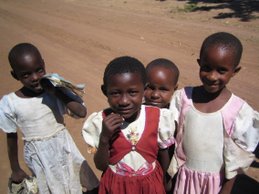
Last class at Hisani Posted by Picasa